Subscribe now to get notified about IU Jharkhand journal updates!

The Primary objective of this study is to elaborate the impact of digitalization on the work-life balance of women entrepreneurs. Digitalization is the application and incorporation of new technologies into daily life across all sectors and industries. The rapid advancement of technology is contributing to a rapid rise in female entrepreneurship in India.The fastest-growing category of entrepreneurship worldwide is female entrepreneurs, who have attracted the attention of numerous academics. Female Digital Entrepreneur has been characterized as a female entrepreneur who investigates market opportunities and takes advantage of the digital space to make a new thing. Entrepreneurs face numerous obstacles and conflicts. Nevertheless, it is evident that female entrepreneurs experience a greater number of conflicts than male entrepreneurs due to society's perception of women and different expectations of them.Work-life balance is often referred to as "work/family," "work/family conflict," "family-friendly benefits," "work/life programs," "work/life enterprise," and "work/family culture." the present paper also focuses on different propositions and models related to the work-life balance of women entrepreneurs in the digital period. The research study has found that women are able to overcome their challenges during the growth of their businesses by utilizing a combination of personal attitudes like their passion, determination, perseverance, ambition, and technical skills. Working outside of Business premises with ICT—smartphones, tablets, laptops, desktops, and computers can aid in achieving a better work-life balance. The findings of this paper are based on secondary sources as well as content analysis of scholarly articles published in reputable journals.
Introduction
Before the 20th century, women began starting businesses to help support their families during unexpected financial or personal challenges, such as the loss of a spouse or divorce. Today, the concept of female entrepreneurship has become widely accepted, reflecting a greater sense of freedom and independence, driven by the rise of feminism and the digital age (Jain et al., 2018). Historically, entrepreneurship was largely dominated by men, but technological advances and changing times have shifted this trend, making women prominent and inspiring entrepreneurs in modern society (Broto et al., 2017). As a result, women are now starting businesses with the aim of creating more job opportunities, encouraging creativity, and contributing to national economic growth through their entrepreneurial efforts (Jain et al., 2018). In India, women's professional roles and career paths have significantly evolved due to rapid urbanization, industrialization, and breakthroughs in information technology (Khateeb, 2011). Since World War II, women have started building their own business networks, building trust with customers, suppliers, and financial institutions, and achieving success in their careers (Kingdom, 1988). The government is also conducting various training programs to enhance women's technical skills and support their business growth in the digital era. Organizations such as the Federation of Ladies Organizations (FLO), the Technology Development Board (TDB) under the Department of Science and Technology, the Entrepreneurship Development Institute of India (EDI), and the Federation of Indian Chambers of Commerce and Industry (FICCI) are involved in these initiatives (KHATEEB, 2011). Many successful Indian women entrepreneurs have used advanced technology to manage household responsibilities while expanding their businesses to remarkable levels. These women serve as role models for others, such as Kiran Mazumdar Shaw, founder of Biocon Limited, and Falguni Nayar, founder and CEO of Nykaa. Others like Shahnaz Husain, founder of The Shahnaz Husain Group, and Vandana Luthra, founder of VLCC, are also notable examples. A woman who starts or inherits a business and is ready to take on financial, administrative, and social risks, along with participating in daily business operations, is considered a woman entrepreneur (Mahi Uddin & Manir Chowdhury, 2015). In today's technologically advanced world, women are making progress and achieving success in all fields; however, they still have to deal with housework, and there is little change in this aspect. Therefore, work-life balance is under threat due to the increasing demands of both family and the workplace (Thriveni & Rama, 2012). When it comes to running a business, women face a wide range of issues, starting with funding challenges, followed by work-family conflicts, lack of professional connections, the ability to take risk take risks, experience, and confidence (Poggesi et al., 2019).
LITERATURE REVIEW
Digitalization and globalization have shown women that they need to work as hard as men in order to gain recognition and provide financial support for their families (Agarwal & Lenka, 2015). Studies have found that the primary motivation for women to enter entrepreneurship is the desire to successfully balance work and family responsibilities (Bardasi et al., 2011). Women entrepreneurs are motivated by both push and pull factors (Patil & Deshpande, 2021). Pull factors include self-independence, dedication, passion, and positive work, whereas push factors are related to job loss and the death of a spouse, as well as family financial difficulties (Patil & Deshpande, 2021). However, women entrepreneurs face more challenges than their male counterparts due to their dual responsibilities—managing a business and caring for a family. These conflicts also influence their investment decisions (Bozoğlu Batı & Armutlulu, 2020). Digitalization has helped women entrepreneurs overcome several challenges such as limited educational opportunities, lack of experience and training, restricted mobility, lack of family and institutional support, and difficulty in accessing financial resources (Cardella et al., 2020). In addition, technology has allowed women entrepreneurs to connect with successful businesspeople and overcome the effects of gender discrimination and societal stereotypes (Pareek, 2017).
A new trend in the digital era is the term "mumpreneur," which refers to mothers who use home-based businesses to effectively balance work and family life (Resurreccion, 2016).
WORK-LIFE BALANCE
Work-life balance refers to the level of satisfaction a person experiences in both their work and family roles (Kalliath et al., 2015). Due to increased education and employment opportunities, women now have to take on dual roles at home and in the workplace (Yamuna, 2018). The main factors affecting the work-life balance of women entrepreneurs in India include role conflicts, lack of recognition, gender discrimination, challenges in elderly and child care, poor health, difficulty in managing time, and a lack of adequate social support (Rangarajan, 2018). However, in the digital era, women entrepreneurs can now access information and job platforms from a single location, helping them develop their businesses according to their needs (Singh & Kumar, 2022). Using advanced technology in business allows women entrepreneurs to maintain a better work-life balance. Women entrepreneurs often rely heavily on their partners' (husbands') support as part of their support network (Ionescu & Ionescu, 2015). In addition, family involvement in both the start-up and growth phases of a business can provide positive support through resources, encouragement, norms, values, social capital, and networks (Poggesi et al., 2015). The great and brilliant scientist Albert Einstein once said, “Life is like riding a bicycle. To keep our balance we must keep moving. If there is an imbalance while riding, the rider may fall.”he cannot control it (Thriveni & Rama, 2012).
Based on their involvement, the authors, Ukonu and Tafamel, divided female entrepreneurs into three categories.
| Conventional Entrepreneurs | Innovative Entrepreneurs | Domestic entrepreneurs |
|---|---|---|
| Who are extremely committed to both traditional gender roles and entrepreneurial concepts. | Who have a strong belief in ideas for starting their own business but have a low attachment to traditional gender roles. | Who structure their work life around their family, hold a strong belief in traditional female roles, and are low attached to entrepreneurial concepts. |
Conventional Entrepreneurs Innovative Entrepreneurs Domestic entrepreneurs
Who are extremely committed to both traditional gender roles and entrepreneurial concepts. Who have a strong belief in ideas for starting their own business but have a low attachment to traditional gender roles. Who structure their work life around their family, hold a strong belief in traditional female roles, and are low attached to entrepreneurial concepts.
According to (Wepfer et al., 2015), women entrepreneurs' work-life balance is affected by five family life stages. (1) Young adults without children, (2) Parents of preschoolers,(3) Parents of children of primary school age, (4) Parents of children older than 12, (5) Adults with grown children. According to the findings of the researchers, women in primary child-rearing family life stages 2 and 3 may feel more burdened than men with the demands of the private domain. however, When children are grown and have left home, family-life stage 5 was the best for work-life balance (Wepfer et al., 2015). Work-life balance was moderate in family-life stages 1 and 4.
The term "work-life balance" has been described as 1) a variety of roles; 2) fairness across all roles; ( 3) contentment in multiple roles; ( 4) achieving role salience across multiple roles; 5) a connection between mediation and conflict; and (6) the perception of control over various roles (Resurreccion, 2016).
The process of becoming a female entrepreneur in relation to gender and life issues was illustrated in four ways by the author, (Gherardi, 2015), as a firm-creator, as a co-author of a design, as a responsible woman , as a member of the alternate generation.
1. A Firm Creator- Self-starting new businesses based on innovative ideas.
2. Co-authoresses- These women are referred to as "co-authoresses" because they co-created the business idea with their partner.
3. Responsible Woman- An arrangement in which the hubby was in charge of the product and the woman was in charge of the executive and counting liabilities to achieve work-life harmony. The authors of this line are also called circles of the co-authoresses.
4. Member of Second Generation- women who chose to join the family business.
It is essential to maintain a high level of work-life balance for both personal satisfaction and the organization's objectives (Prabhushankar & Amit, 2016). The works of literature presented numerous theories on work-life balance, some of which are:
1. Segmentation Theory-This theory, which is argued to be one of the foremost proposition on work-life balance, asserts that family life and work life are innately separate and segmented. The two disciplines are regarded as distinct realities (Khateeb, 2021).
2. Integration Theory - Contrary to segmentation theory. The Modern understandings of integration theory rethink traditional work-life paradigms to make all stakeholders, including workers, families, and communities, active partners. Although non-work and work can be combined, the two phenomena operate independently. There is no distinction between work-related and home-related possessions.
3. Theory of Achievement: The Theory of Achievement was founded by David McClelland. This theory divides emotional requirements into three categories: affiliation, accomplishment, and power. This theory states that women entrepreneurs are driven to seek success and excellence in their businesses (Panday & Sharma, 2022).
4. Boundary theory of work-life balance -Zerubavel established the boundary theory of work-life balance in the year 2000. The Boundary theory of work-life balance states that people's perceptions of the relationship between their various roles influence how they manage the boundaries between work and life (Kelliher et al., 2018). Segmentation occurs when roles are thought to be mutually exclusive, while integration occurs when roles are thought to overlap.
5. Enrichment theory: work and life enrichment theory was developed by Powell & Greenhaus (2006) and refers to the extent to which experiences in one role improve the quality of life in the other role (Patil & Deshpande, 2021). Alternately it can also be defined accumulation of cerebral coffers in a given part that is resolve over into another part.
6. Social Role Theory -According to the social role theory, each job has a set of expectations, and an individual is expected to play each role responsibly. People will be disappointed in you if you don't live up to your roles and responsibilities. Therefore, if a woman is unable to flawlessly perform various roles, it disrupts both work and family obligations.
7. Social Identity Theory- The purpose of social identity theory was to explain how men and women establish and define their place in society. Three psychological processes, according to the theory, are crucial in this regard: identification, comparison, and classification of social groups (Neneh, 2021).
8. Spillover Theory -The spillover phenomenon, which was first proposed by Wilensky in 1960 and has been categorized as Positive Spillover and Negative Spillover, involves the work role influencing the family role (Khateeb, 2021). Positive spillover is the phenomenon by which positive experiences in one area lead to fulfilment and success in another. The negative approach is also known as contrast, complementarities, opposition, regeneration, heteromorphy, and other names. This paper presented a conceptual framework for the work-life balance of women entrepreneurs.
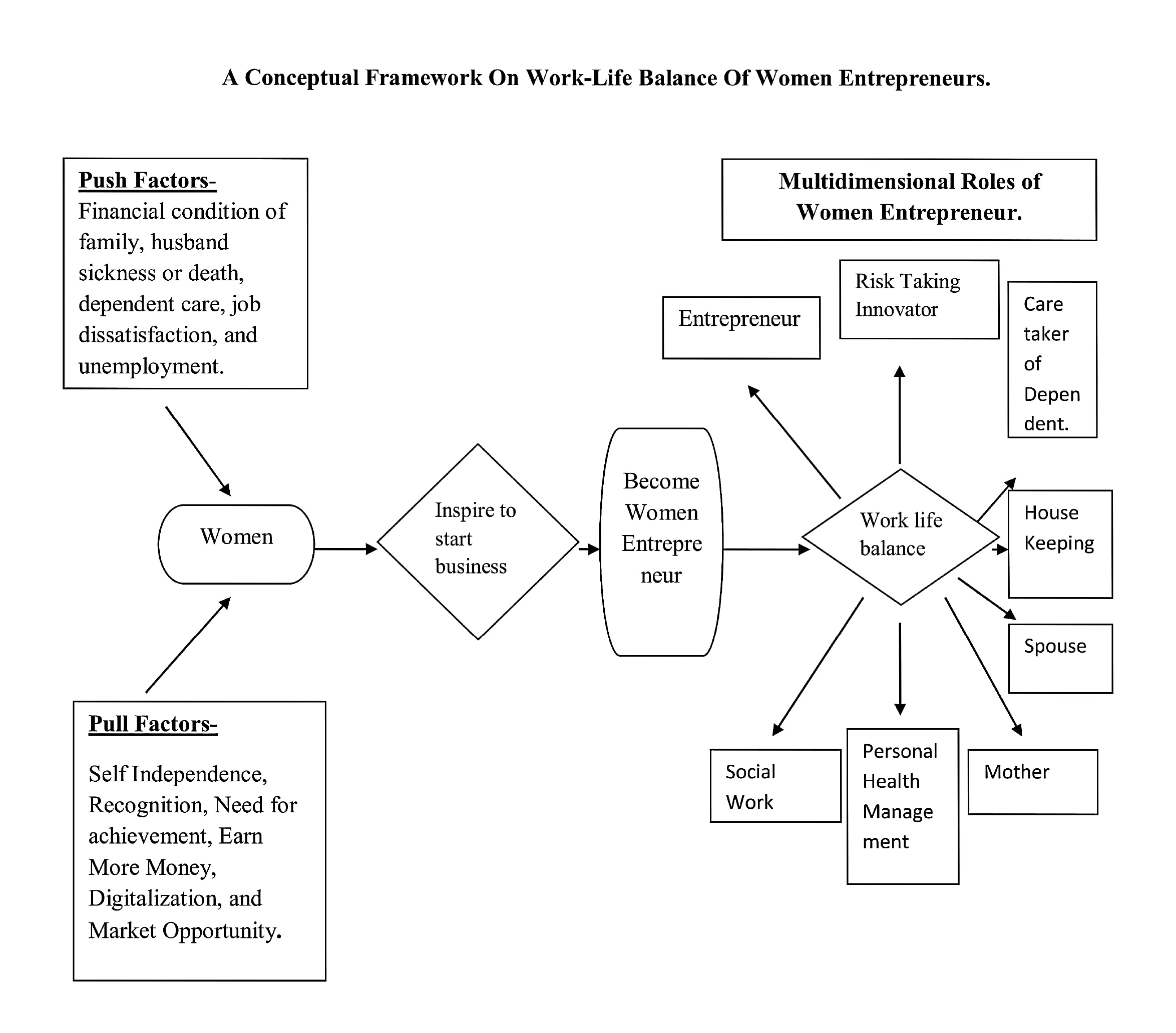
Impact Of Digital Era On Work- Life Balance Of Women Entrepreneurs
Work practices like telecommuting, distributed teams, online work, and even entirely virtual businesses are increasingly being referred to as "digitalization," which refers to the empowerment of businesses and entrepreneurs with newfound freedom and flexibility in the workplace (Chopra, 2022).
It is probably true to say that technology dominates our workplaces and is having the same effect on our domestic life as well, Not that long ago, the only tools on an office desk were a telephone and a typewriter (Byrne & Byrne, 2014).
Now the time has changed, Every office uses a computer, the internet, software, and numerous technological devices to do its work. Women entrepreneurs are actively using pamphlets, e-mails, SMS, Facebook, and Instagram to market their products in the digital era and reach wider locations of customers by staying in one location (Mustapha & Subramaniam, 2016).
Hence Women entrepreneurs' work-life balance is improving as a result of the use of advanced technology. It is increasingly helping women entrepreneurs manage their time and improve their work-life balance.
Because of the asymmetrical distribution of household responsibilities in traditional societies, the issue of work-life balance is more difficult for women entrepreneurs in comparison to men entrepreneurs (Jameel Ahmed, Nadia Saleem, and Kaneez Fatima, 2019).
Flexible working arrangements are one of the most important tools for women entrepreneurs to maintain a better work-life balance. These flexible working arrangements are made possible by the use of mobile devices, the digitalization of work processes, and online communication.
Work-life harmony is the broadest term than work-life balance because, Work-life harmony fosters synchronization within oneself and allows a person to assist others in creating, whereas work-life balance focuses on one's own mentality (Tariq, 2012).
Digitalization makes it easier for women entrepreneurs to maintain work-life harmony in the organization.
For instance, it has been observed that women's use of laptops, the Internet, and mobile phones have made it easier for them to effectively manage and schedule their family affairs while working.
The Authors Mervi Rajahonka and Kaija Villman described the Domestication theory.
Domestication theory – The process in which entrepreneurs reform innovations, particularly new technology, to better fit the organization.
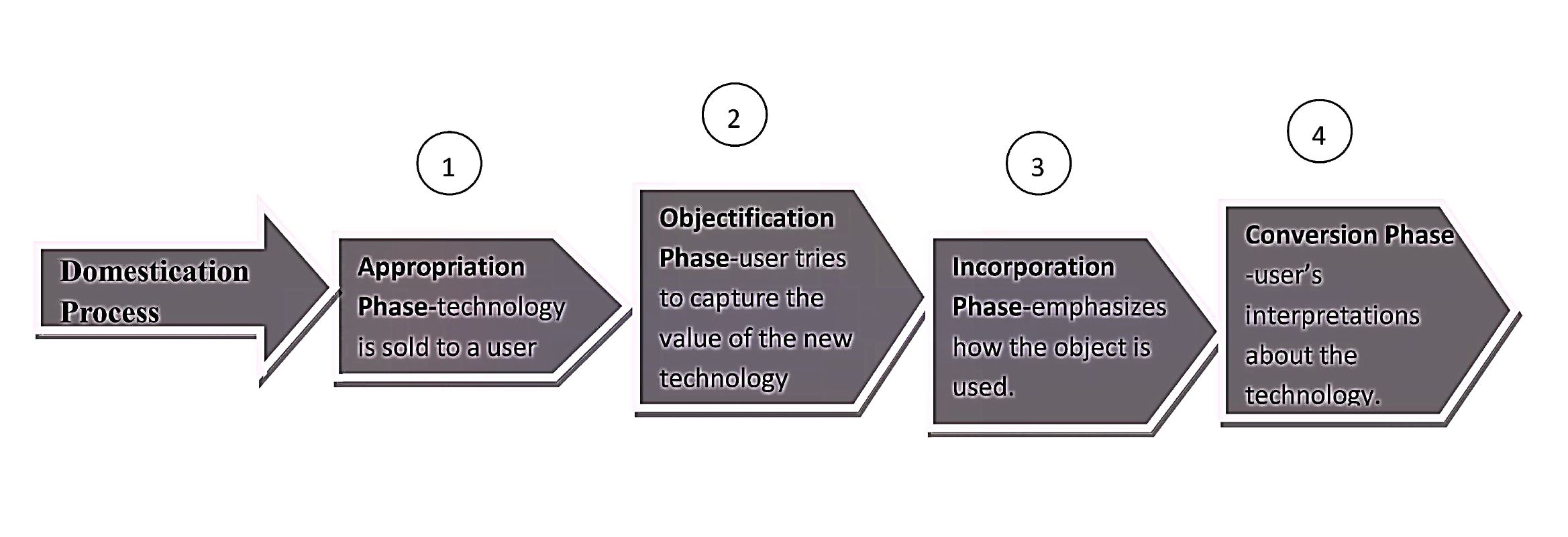
The appropriate domestication procedure ought to be followed by all female entrepreneurs.
It makes it easier for women entrepreneurs to achieve their goals of the organization and work-life balance. Technology alone is not sufficient to solve these issues. Instead, it is largely dependent on how it is installed, what information it contains, and how it is carried out.
Utilizing technology in accordance with the needs of the organization and providing appropriate training to both the employer and employee is crucial. For instance, if a woman entrepreneur wants to install online software like ERP, it must first be designed to meet the needs of the organization.
Second, employees and entrepreneurs must be aware of the software's functions and properties before it can be used effectively. By doing this, the organization's goal and women entrepreneurs' work-life balance can be achieved.
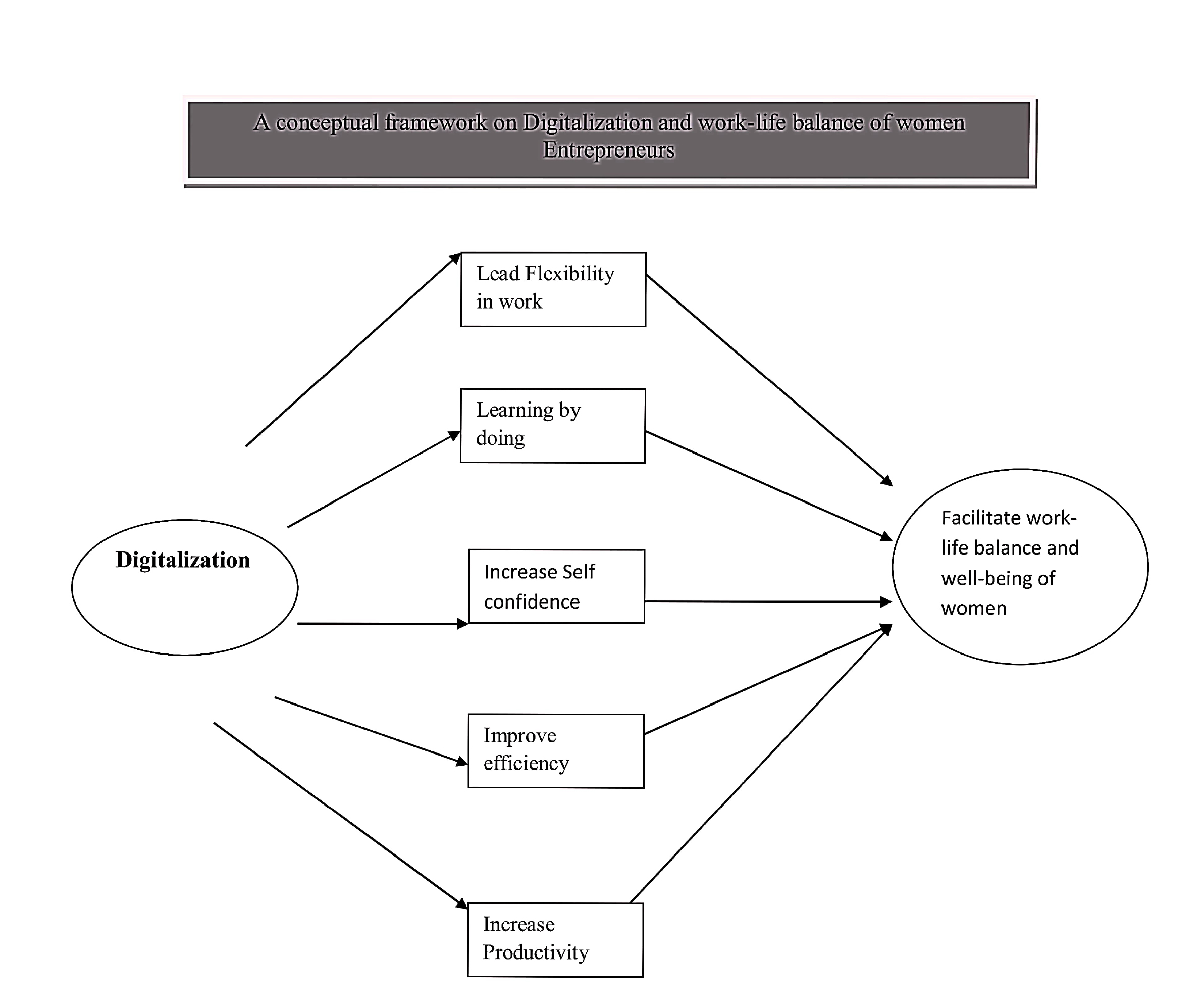
RESEARCH GAPS
1. Women entrepreneurs' coping strategies for managing both their families and employees.
2. Evaluate the adverse impact of work-life balance issues on women's empowerment, economic growth, employment, and social and economic development in India.
3. Comparing work-family conflicts’ coping strategies of both men and women entrepreneurs.
4. How do various contexts, such as organizational, family, high technology, and cultural environments, affect women's business and family lives?
RESEARCH FINDINGS
Digitalization refers to the conversion of information into digital format By using computers, smartphones, and internet, etc. There are a lot of pull and push factors that encourage women entrepreneurs to move forward, but digitization is now emerging as one of the most significant factors that encourage women entrepreneurs because this is due to the following reasons:
1. Women today have access to a wide range of digital tools that allow them to enhance their entrepreneurial abilities such as communication, passion, determination, hard work, ambition, personality, self-confidence, autonomy, work-life balance, technical knowledge, and dedication to work.
2. Women can market their products worldwide from a single location using a variety of digital tools and digital social media, such as Facebook, Instagram, YouTube, e-commerce sites, and numerous apps.
3. Digitalization makes business more interesting, makes work more efficient, and makes it easier for women entrepreneurs to effectively manage their time so that they can balance their personal and professional lives.
CONTRIBUTION TO THE EXISTING LITERATURE
Women entrepreneurs are becoming increasingly interested in starting their own businesses as a result of digitalization. Digitalization has the greatest impact on female entrepreneurs because it makes business work more flexible, increases risk-taking innovation, and opens up more economic opportunities.
In the years to come, there will be an increase in the number of women entrepreneurs in every sector. Entrepreneurship is very rewarding but It can be frustrating and stressful at times. However, it can be overcome by employing the appropriate strategies, such as effective time management, a flexible work schedule, assigning tasks to the appropriate peoples, and making effective use of digital tools like software, apps, e-commerce sites, etc.
Women must always strive to improve required skills such as proper time management, self-confidence, passion, technical knowledge, strong dedication, and proper communication to obtain sustainable growth of business and healthy work-life balance.
It is extremely challenging for women to balance work and family life, but the perception of society has changed in some way as a result of digitalization and globalization, and the government is also conducting numerous training programs for women entrepreneurs to encourage and assist them.
Innovation, recognition, family bonding, support, and achieved freedom all have a significant impact on entrepreneurial satisfaction. The research found that start-up entrepreneurs are successful at achieving a healthy work-life balance. This is due to their familiarity with a wide range of digital tools and technologies.
The above study also revealed that women entrepreneurs are able to strike a work-life balance by properly domesticating digital tools combined with the necessary self-management skills.
REFERENCES